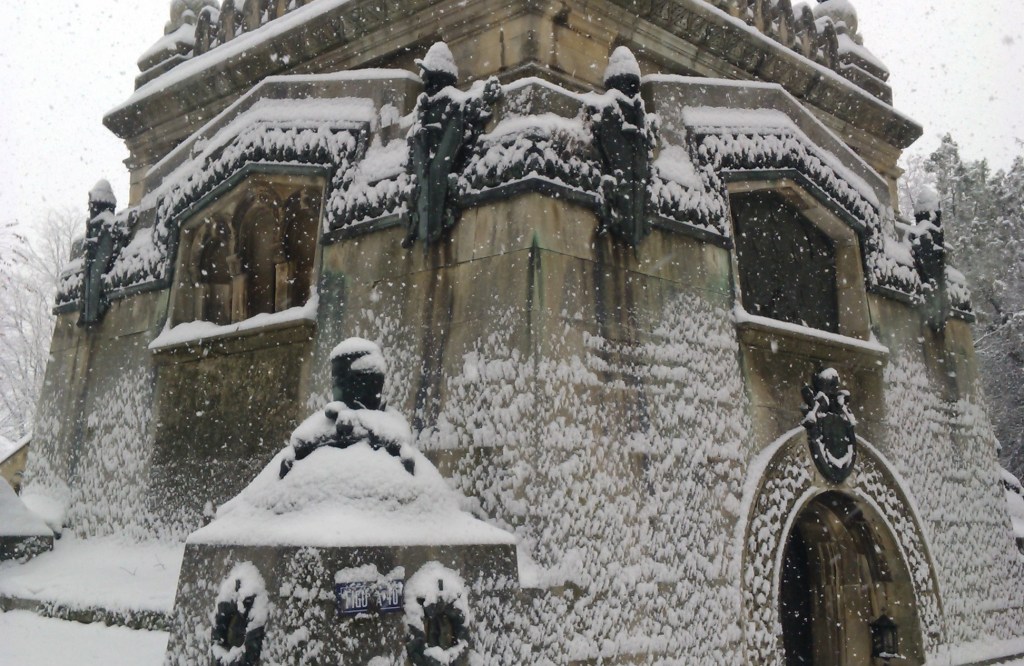
Today, I will take you on a new trip, so grab my hand and let’s enjoy the walk.
We are going to one of my favourite places in Bucharest. Yes, I know what you’re thinking… I seem to have many favourite places. And you’re right.
This one might surprise you, though.
It is a cemetery.
Not just any cemetery, but one filled with history. It is like a garden where history, architecture, nature and memory all meet.
I love this place in every season. It has a quietness that is difficult to explain, as if time itself slows down while you walk among the old trees.
There is an epitaph here that always stays with me:
“If you have entered, tread softly. I have scattered cherry blossoms. They are white and soft… tread gently.”
I think those words describe this place perfectly.
Now, while we enjoy our walk, let me take you on another journey—the journey through its history.
Our first stop may surprise you.
Long before it became a cemetery, this place was an orchard. Yes, an orchard. I know we don’t really grow oranges in Bucharest today, but back then this was an orange garden where people came to relax, eat, talk and simply enjoy life.
The estate belonged to Chancellor Alexandru Bellu, also known as Old Bellu.
But history rarely lets a place remain peaceful forever.
In 1821, the army of Tudor Vladimirescu camped here because the garden occupied an important strategic position.
Now you may wonder…
How did such a place become one of Bucharest’s most famous cemeteries?
Come with me.
We are going to meet the mayor of Bucharest.
He decided that the old cemeteries in the centre of the city should no longer be used and that new ones should be created outside the city limits.
Back then, this garden stood on the very edge of Bucharest. Yes… the city was much smaller than it is today.
The son of Chancellor Bellu, who at that time was the Minister of Justice and Culture, decided to donate the land for the new cemetery.
The monks from Văcărești Monastery followed his example and donated additional land.
Now let us move to the year 1852.
The cemetery is finally ready.
The first person buried here was the daughter of C. A. Rosetti, one of the great politicians and writers of his time.
If you still have the energy to keep walking with me, let’s travel a little further. Bellu Cemetery covers almost 30 hectares, so don’t worry—we won’t see everything today. Every path seems to hide another monument, another forgotten story, or another remarkable person waiting for us to stop and listen.
In 1899, the cemetery church and several of the surrounding buildings were completed. They replaced the small church that had stood here before.
During the following years, new sections were added—a Catholic cemetery, a Protestant cemetery, a military cemetery and a Jewish cemetery—making Bellu a resting place for people of many faiths and backgrounds.
Now let us walk into the early 1900s.
Near the cemetery there was once an inn where people gathered to eat, drink and enjoy themselves.
Its famous inscription read:
“Better than the one across the road.”
Across the road, of course… was the cemetery.
Bucharest has always had a peculiar sense of humour.
Another local tradition says that around 1916 there was also a small cemetery known as the Thieves’ Cemetery, which was later incorporated into the military section.
Around the same period, a greenhouse was built nearby so the citizens of Bucharest could grow flowers.
Now…
Let us return to the present.
Today Bellu Cemetery is also an open-air museum, and during the Night of Museums you can even visit it after dark.
Imagine walking these quiet paths in the middle of the night, surrounded by statues, old trees and history.
Perhaps we could stop and say hello to the remarkable people resting here.
Maybe they would tell us the stories of their lives.
We could visit Ion Luca Caragiale and ask him how he managed to write characters that still feel alive today. Politics still seems full of Dandanache, and it often feels as if A Lost Letter could be performed again today without changing a single line.
Then we could greet Mihai Eminescu. Be careful, though… he seems to have loved coffee even more than I do. Perhaps he would tell us how his poems were born, or maybe he would simply smile and let us wonder.
Not far away we could visit the famous mountaineer whose beautiful monument has always reminded me of one of my favourite writers. Perhaps she would tell us her own story.
Then we might visit the richest man in the cemetery. If we are lucky, perhaps he would finally tell us whether the old legend is true—that he was so wealthy he once thought about paving his castle with gold coins. If the legend isn’t true… well, at least we can admire one of the most impressive tombs in the cemetery.
Or perhaps we should continue our walk to the mysterious Lady with the Umbrella. People say she died while waiting for someone. Maybe it is only a legend… but wouldn’t you like to hear the story from her instead?
Then there is Iulia Hasdeu. Perhaps she could explain why her tomb was designed the way it was and tell us something about the world of spirits that fascinated both her and her father. I imagine that would be quite an extraordinary conversation.
We could also stop beside Constantin Tănase. Perhaps we could ask him about the famous saying, “Give us your watch! Give us your coat!”—the satirical phrase that became a symbol of the Soviet occupation after the Second World War. Knowing Tănase, I think he would still have something witty to say.
And I would certainly ask him about the day he rode through Bucharest in a carriage pulled by an ostrich. Even by Bucharest’s standards… that was wonderfully unusual.
Or perhaps we could simply visit Birlic and ask him to tell us one more story.
Or maybe… we don’t need to ask anyone anything.
Maybe we should simply wander through the alleys, admire the sculptures, listen to the birds and let history whisper on its own.
This place is full of stories.
And if you would like to walk a little further with me… just let me know.
We have only explored a small corner of Bellu today, and I still have many more stories waiting for us.


Very nice pictures:)
LikeLike
Thanks 🙂
LikeLike
i would love to make that walk with you:)
LikeLike