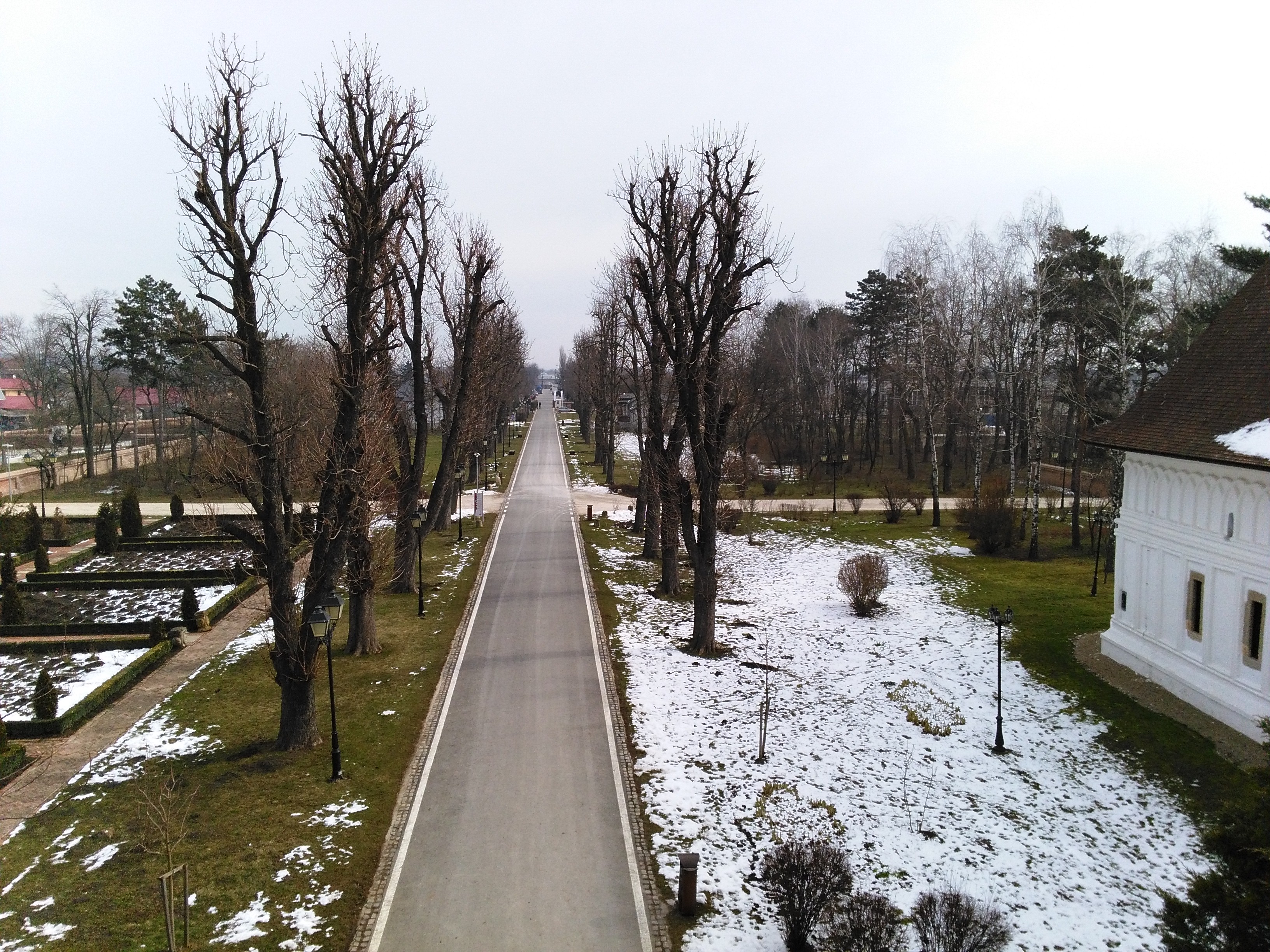
Grab my hand. Today I will take you to a place I think you will love.
We won’t have to travel very far from Bucharest. In fact, if you enjoy long walks, we could even walk there together. It would only be around ten kilometres. So, where are we going this time?
To a palace.
But before we admire its beauty, let me take you on a little journey through its history. Every old building has a story, and I think stories make places come alive.
So, grab my hand tightly… and let’s begin.
Our first stop is the year 1698.
The palace is only beginning to take shape. Workers are laying the foundations while Constantin Brâncoveanu, Prince of Wallachia, watches his dream slowly become reality.
Long before the palace existed, this land belonged to the widow of the boyar Mogoș. Her name remained attached to the estate, and even today the place is known as Mogoșoaia.
Now let’s move forward a few years.
It is 1702, and the palace is finally complete.
Its elegant architecture will later become known as the Brâncovenesc style, a style unique to Wallachia that beautifully blends Renaissance, Ottoman and Byzantine influences.
Like many great residences, the palace will serve different purposes throughout its life.
Come… let’s take another step through time.
It is now 1714.
Perhaps we could stop here for a meal or even spend the night, because after the tragic execution of Constantin Brâncoveanu and his sons by the Ottomans, the palace was transformed into an inn.
History can be cruel.
And unfortunately, it would not be the last difficult chapter for Mogoșoaia Palace.
Let’s continue.
Between 1768 and 1774, during the Russo-Turkish War, the palace suffered heavy damage.
But wars rarely spare either people… or beautiful buildings.
Fortunately, brighter days would come again.
Prince Grigore Ghica granted the estate to his daughter Zoe Mavrocordat, who married George Bibescu, the future Prince of Wallachia.
The palace remained in the Bibescu family and was lovingly restored by Nicolae Bibescu, bringing elegance back to its halls.
But history has a habit of repeating itself.
Let’s move to 1916.
The First World War has reached Romania.
German aircraft bomb the palace, leaving it badly damaged once again.
Luckily, Princess Martha Bibescu refused to let it disappear.
She spent much of her own fortune restoring it, and before long, the palace became one of the favourite gathering places for artists, writers, diplomats and members of high society.
Sadly, peace did not last forever.
After the communist regime came to power, the estate was nationalised.
Only in 1957 did the palace begin a new life as a museum, allowing everyone to enjoy its beauty.
Now…
Enough history.
Let’s simply enjoy the place.
Walk with me through the gardens.
Look at the peaceful lake reflecting the palace.
Admire the elegant Brâncovenesc columns and the carved stone details that have survived for more than three centuries.
If you wish, we can step inside the little church, light a candle, and enjoy a few quiet moments.
The museum also hosts changing exhibitions, and you can even see architectural fragments rescued from the old Văcărești Monastery, a remarkable monument that sadly no longer exists.
Or…
We don’t have to do anything at all.
We can simply sit on the stone steps by the water, listen to the birds, watch the reflections dance across the lake, and let history slowly unfold around us.
Sometimes…
That is the best way to discover a place.
I hope you enjoyed our little walk through Mogoșoaia Palace.