Tag: short-story

Story crime

On my search for a crime to fit my story, I found another interesting one. Again, it is not really fitting my story, but it is still interesting.

So imagine we are in 1935. You are a beautiful lady, the first one to win the title of Miss Romania, plus some other beauty contests in Germany. You would like to be an actress. Your father is a Communist activist, quite prominent at that time. Because of your beauty, every door opens for you and you move in high circles. You even have an affair with Liviu Ciulei, who at that time was a prominent engineer.

It is Christmas Eve, at the fatal hour of 23:00. Your sister comes to visit you with your friend. You are happy and you talk about the man who will soon become your husband, Cuza Hotta, with whom you had gone to the train station because he did not want you to spend a night alone on a train. That is why you returned to Bucharest in the end.

Out of the blue, your face starts to look different. You tell them you feel sick. Your sister brings you a glass of water, but you feel even worse. Your sister gets alarmed and sends your friend to her husband for help. Her husband calls several doctors, but none of them is at home. So he takes a car to bring an ambulance or a doctor, but unfortunately, when he returns, you are already dead.

Everyone is in shock: society, your family. You were very young, only 27 years old. But what was the reason for your sudden death? A classic murder weapon: potassium cyanide.

Your father, who at that time was financially supported by you, denounces your lover, claiming that he killed you. He used to be your lover, but there was no fight, no clear reason to kill you. Could it have been a crime of passion, even though you were about to marry?

The question was: crime, accident, or suicide? You were taking laxatives every night. The question then became: how did the poison get into your body? This poison is known to provoke lesions in the mouth and from the beginning to the end of the stomach. But the medical report did not show such lesions. In the report, it was evidenced that the substance from the laxative was present in the stomach, so either you took the poison with the pill or with something else.

Nobody believed you had reasons to kill yourself. You were young, beautiful, with a good future ahead. Plus, the way you acted on your last night, even taking your laxative pill, did not fit the suicide story. So they started to think that you took the poison by mistake, by accident, with your pill — or, better said, inside your pill. Maybe when the pill was made, something went wrong.

They searched how the casing of the pill was made. They figured out that just one pill could not be poisonous, so the accident theory was kind of ruled out. Crime was all that remained. But why did your father think your lover killed you?

Well, yes, it was said that he did visit your brother-in-law to find out if you really wanted to marry that man. There, it seems he found out that you indeed would marry him. Then it was supposed that he went to a metal factory, which he owned, and got the poison from one of its sections. After that, when he came to your sister’s place, he was violent, and later he went to the bathroom, where he could have poisoned your pills (which were more like powder pills).

When he was asked about that visit, he said he went to tell her what he thought about her, and in another declaration, he said he went to give her a Christmas present.

Anyway, a lawsuit started. How it ended — I will tell you tomorrow.

Hmm… I hope this story made you curious enough to want more.
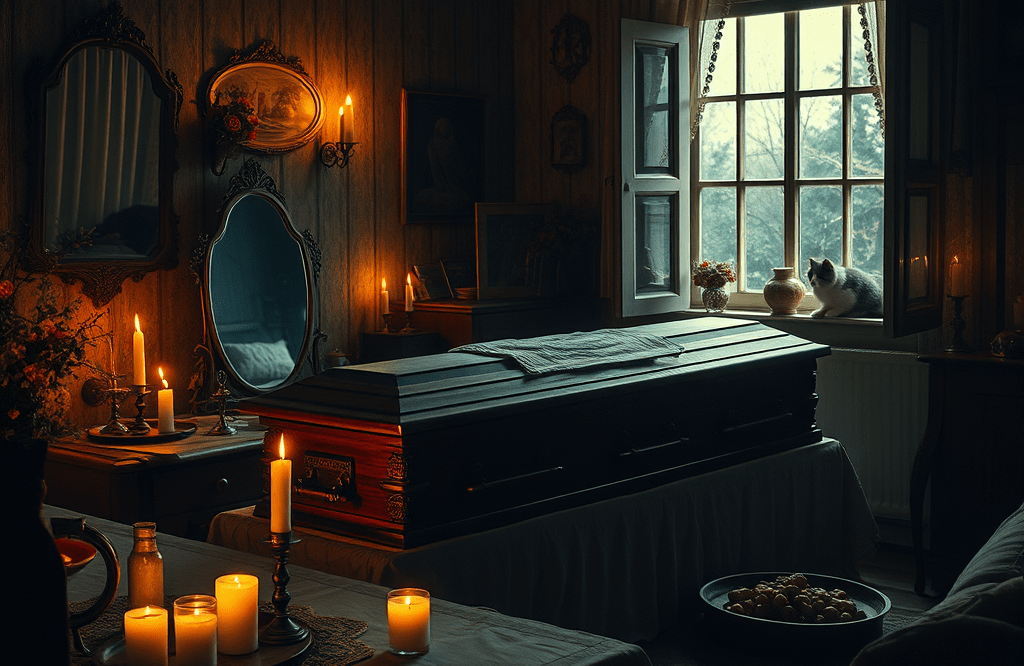
Winter story-2

Well, like I told you, I will tell you more about this story, even if it doesn’t fully fit the story from my dream. Last time I mentioned that there were two men who could have committed the crime, a crime that filled the newspapers at that time, not only because the victim was a prominent woman, but also because it happened on a famous train, perhaps.

Let’s see how the investigation went. As you can imagine, they started by researching the place of the murder and asking questions to the people who were on the train. The train conductor said he had seen a man around 25 years old, with brown hair, smoking in the aisle. He remembered that this young man had a ticket for a journey toward Hegyeshalom, on the Austrian–Hungarian border, and Buchs, on the Swiss border. So this guy became a suspect, as you can imagine.

He fit the description of a prominent Romanian guy who used to take possession of women’s belongings while they were traveling by train. He had an impressive rap sheet.

The investigation continued, and a few days later they found her hand luggage in a room in Basel. Inside those bags, however, there was no trace of her fur coat or her jewelry. At first, the police suspected the Romanian man, Teodorescu, who was known for robbing women on trains. But he was found at his parents’ house, far from the scene, like I already told you.

To gather more information, they did what you can always do: follow the goods. So they did. The investigation then shifted toward locating the missing items. What could they do? They started to look for places where the goods could be sold or transformed into money, so pawn shops were searched, places where such things might have been sold or hidden.

Well, they didn’t find much information there. But unexpectedly, the fur coat appeared in a completely different setting: during church mass in Zurich. Detective Karl Nievergelt recognized it on Johanna Wunderlich, the owner of a boarding house. It almost seemed that God had made a miracle to ease the road to finding the killer.She claimed she had received the coat from a Hungarian student boarder, Karl Strasser, 23 years old, the son of a bank teller.

There were now two suspects: the Romanian man with a long criminal record, and the student, Strasser. From the information I found, it seems that both did it, but the focus was more on the guy who was brought to justice. Even so, from what I found, both had thrown her out of the train. She was still alive when she fell, but she died because of the wounds from the impact. Teodorescu was never captured, and the case was judged without him.

Witnesses came from different countries. From Romania, there was an odd witness, more quiet. The witness was the wagon itself. The wagon in which the crime happened was brought to Leoben so the crime could be reconstructed in front of the court and the jurors. They showed the couch and the window from which she was pushed out. The time of the murder was established as 1:42 in the night of September 26–27.

The killer who was brought to justice, the student,was a small guy, looking even smaller between the big guards, around 1.80 meters. He looked like a regular guy, not someone who would stand out by his looks. More like a public worker from that time, not someone you would think could push a person and kill. He targeted Maria Farcașeanu and waited until she climbed on her seat to reach her luggage. Then he did it.

He seemed to be a man of culture. During the trial, he tried to turn it into a kind of conference, talking about the decadence of his time. Unfortunately for him, this worked against him. The prosecutor used the fact that he was educated to make his situation even worse because an educated man should have known better. The Austrian court sentenced him to death. A request for pardon was made, but it was not approved. Later, the sentence was transformed into life in prison. In the end, two lives were destroyed: the life of the woman, an intelligent businesswoman, and the life of the killer, who destroyed his own life through his deed

Winter story

Let me tell you more about my inquiry. You already know my fascination with old, haunted houses. As you can imagine, I’ve been searching,carefully, patiently for something that feels right.

At first, I thought the answer might lie in well-known crimes from the 19th century. Visiting old houses is enjoyable, of course, but so far it has led nowhere. Without a story, a trace of darkness, a reason, a house is just a building. The only other option would be to wander through Bucharest aimlessly, hoping that chance alone would lead me to the house. But that requires a kind of luck I don’t possess. And if I did, the story would be far too simple. Maybe too easy… don’t you think?

So I began where everyone begins: with research. Hours spent searching the internet, looking for crimes that might fit, events that left something unresolved behind them. I was certain I would find more than enough material.

I was wrong.

What I believed would be an easy task turned out to be frustratingly difficult. There is surprisingly little information available, as if time itself had chosen to erase certain things. Still, during those first searches, I came across a story. It wasn’t what I had imagined, and it didn’t lead me to a house, but it lingered in my mind.

It was a crime that took place on the Orient Express.
Not Agatha Christie’s story, although it is said her novel may have been inspired by this very event.

The crime happened in 1935. The victim was a Romanian businesswoman, found outside the train, at the edge of an embankment. Her body was discovered by a brakeman from a freight train, lying in a ditch. She was barefoot. There was a deep wound near her right eye, evidence of a struggle. In her hand, she held strands of hair, hair that did not belong to her.

Along the railway, scattered over several kilometers, were her belongings: her shoes, an embroidered scarf, a hat, and a handbag containing her identification papers—Maria Fărcășeanu and her train ticket. Any suggestion of suicide was quickly dismissed. Violence was undeniable.

The autopsy revealed something even more unsettling: she was still alive when she was thrown from the train. Robbery was believed to be the motive. The last train known to have passed through that area was the Orient Express, traveling the route Istanbul–Bucharest–Paris. And so, the investigation began.

They soon discovered that Maria had been carrying considerable wealth: expensive jewelry, a diamond wristwatch, pearls, gold pieces, and a luxurious fur coat. Sometimes, it seems, elegance can be dangerous when it draws the wrong attention.

She was an extraordinary woman,a business owner, the founder of an art school, prominent in her field, officially recognized by the Ministry for her work. She owned the first artisanal shop in the country and exhibited in Paris. A pioneer. A wife. A mother. Beautiful. Independent.

And yet, her life ended violently, in the darkness between stations.

Her death caused a sensation at the time, widely discussed in both the Romanian and Austrian press, made even more shocking by the setting,a train already surrounded by legend. The investigation ultimately concluded that two men had thrown her from the moving train.

But this story doesn’t end here.
It feels like a door only slightly opened.

I’ll tell you more tomorrow.

The Night of Saint Dumitru – Fire, Frost, and Miracles

Come on, my dear. Yes, take my hand—like always.
The air smells of smoke and ripe apples, and the wind tastes like old stories. You can almost hear them humming through the trees, calling us again.
Ready for another jump through time? I knew you’d say yes. You always do. Hold on tight. This one’s a long leap—through centuries, through faith, through fire.

The First Dumitru – The Martyr of Thessaloniki

The wind flares hot, and suddenly our boots click on marble streets. We’re in Thessaloniki—long, long ago, when emperors ruled the world and gods demanded sacrifices instead of prayers.Smell that? Incense, sweat, and the sharp tang of iron. The banners of Emperor Maximilian flap in the dry air, scarlet against a sky like melted bronze.There—do you see him? Dumitru, the proud governor, shoulders straight, his armor gleaming. But look closer. Behind those calm eyes, something fierce burns—a faith he cannot hide. He’s Christian. In these times, that’s as dangerous as carrying a spark through a field of oil.When the emperor returns from war, he calls for feasts and sacrifices. Drums thunder. Wine spills. But whispers reach his ears—the governor refuses the old gods.

They drag Dumitru before him. You squeeze my hand—you know what’s coming.“Yes,” Dumitru says, his voice calm as still water. “I believe in one God.”And there it is—the moment when courage becomes legend.They throw him into a dungeon. You can almost feel the chill of the stone walls, the damp smell of earth and iron. When the soldiers come, torches flickering, they strike him with spears…But then—light. Golden, blinding light spilling from every wound, until even the guards cover their faces.He dies, yes. But not quietly. The air trembles with something holy, something eternal.
I glance at you, and you nod. You can feel it too. The moment faith becomes flame.

The Second Dumitru – The Hermit of Basarabov

The marble crumbles under our feet, and now we’re standing among cliffs and moss, the air cool and clean, tasting faintly of rain. We’re in the 13th century now, near Basarabov, a small village folded in green hills and silence. The river hums nearby, soft as a lullaby.There, in a cave carved by wind and time, lives another Dumitru. You smile—you already know his kind. The quiet souls, the ones who talk to stones more than to people.No armor here. No throne. Just rough cloth, bare feet, and prayers whispered to the wind. He eats roots, drinks from the river, and knows the language of birds.

When he feels his time drawing near, he lays himself down between two stones shaped like a coffin.
“I came from dust,” he whispers. “To dust, I return.”And when he passes, the air in his cave smells of wildflowers.Centuries later, they’ll carry his relics to Bucharest—candles flickering, people weeping softly.
But if you close your eyes now, you can still hear the song of the river, and maybe… just maybe… his voice carried on the mist.

The Nights of Saint Dumitru

We step back into our own time. The air shivers with cold, the sky deep as ink. Around us, hills glow with hundreds of fires. The smell—ah, that smell!—smoke, apples roasting, the faint sweetness of wine.“Tonight,” I whisper to you, “Saint Dumitru closes autumn’s gates and wakes the wolves.”Flames leap high, painting faces gold and red. Children laugh as they jump over the fires, chasing health and luck through the sparks.You nudge me and grin. “Think I should jump too?”“Only if you want love this year,” I tease, and you laugh—the kind of laugh that fits perfectly under a night like this.

Old women hand out nuts, apples, bagels, and grapes, their shawls smelling of herbs and wood smoke.And somewhere beyond the firelight, a wolf howls. Not with hunger. With joy.

The Wolves’ Blessing

This is their night too.
They say Saint Dumitru walks the forests at midnight, his cloak woven from moonlight and frost, his hands gentle as snow.He touches each wolf on the head, blessing them for the long winter ahead. If you’ve kept faith, they’ll guard your home.
If not… well, let’s hope you’ve left a few bones at the edge of your garden.You squeeze my hand again as we hear another howl. Don’t worry—it’s a good one. You can tell by the sound.But remember the rules:
No knives tonight. No combs. No planting garlic after Saint Dumitru.
The spirits of the season dislike being disturbed. Let them dream in peace.

The Market of Saint Dumitru

The next morning, smoke fades and the air smells of fresh hay and baked bread. The fair has begun!Color everywhere—scarves, ribbons, wool, laughter. Fiddles cry out and feet stamp on packed earth. The smell of roasted chestnuts makes your stomach growl, and I grin, handing you one.This is how the people mark the end of the harvest—the last dance before winter claims the fields.
And maybe, just maybe, it’s how they find a little love before the snow falls.

You look around at the laughter and music, and I catch your smile. I’ve seen it every autumn since forever—it’s the smile that says, “We made it here again.”

The Saints’ Blessing

As dusk returns, we sit on the last hill where the fires still glow. The air is colder now, the stars sharper.

Saint Dumitru walks once more between the worlds, closing the door to autumn, opening the gate to winter.
He blesses the brave, the kind, and those who still dare to dream when the nights grow long.

I turn to you. “No knives, no combing, no quarrels,” I remind you softly.
You chuckle. “You always say that.”
“And you never listen,” I say, smiling.

The fire crackles. The wolves sing somewhere in the dark.
And together, we whisper our wish into the smoke—because on the Night of Saint Dumitru, every wish carries a spark.

So let it fly, my friend.
The saints are listening.
And the wolves are smiling.