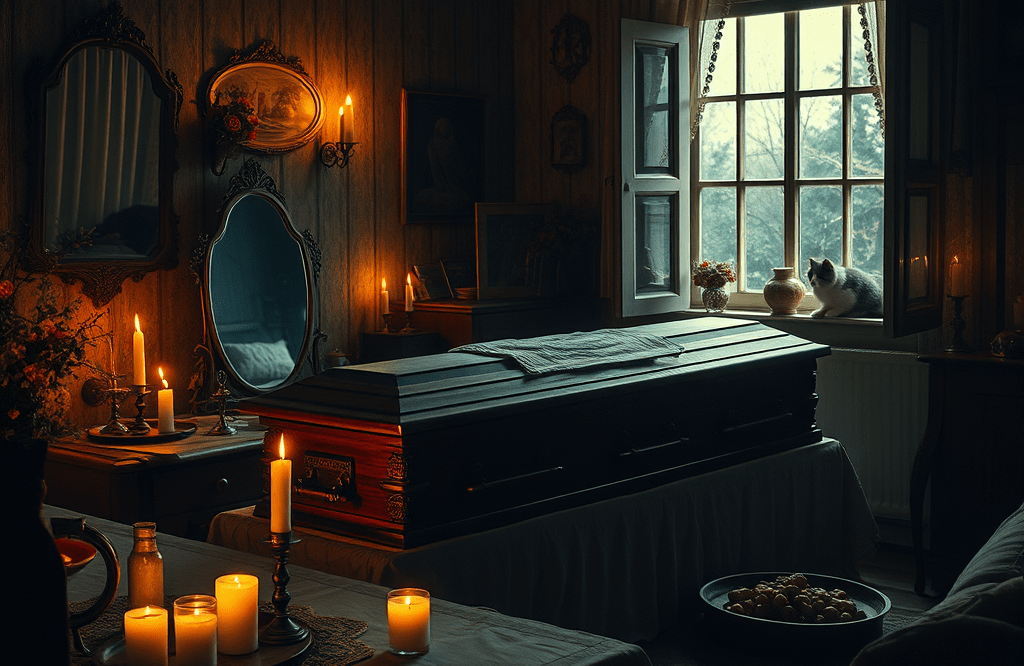
Hey — come on, take my hand. Tonight we’re going somewhere a bit different. Think of it like an after-hours walk through other people’s old beliefs: curious, a little mysterious, and maybe a touch mischievous. Ready? Good. Let’s go.
“Ugh, really? Death?” you whisper.
“Yep,” I say, grinning. “Nobody gets out of this one. So let’s be prepared — and entertained.”
The Beginning — When Someone Passes
So picture it: someone close has just died. Not the happiest scene, I know, but this is where everything starts. Years ago the deceased would stay in the house. Now, most people go to a chapel — but in the countryside they still bring the body home. I’ve seen it.
“Home? Like, with a coffin in the living room?” you ask, eyes wide.
“Exactly that. Cozy, if a little drafty.”
First thing: cover every mirror and every shiny surface. Fast. No reflections allowed. The old story says if the dead person is reflected, they might get a bit… undeclaredly alive again — a touch ghostly. Also: practical reasoning. Imagine catching your own reflection and thinking somebody’s standing behind you. Nope.
Then, close family or friends wash the deceased carefully — a soft, intimate thing. After that the person is dressed for the journey and placed in a coffin.
The Three-Day Vigil
Now the coffin stays put and people come. Flowers, candles, food. Always food. We set out treats and drinks for visitors — a hospitality thing, even for grief.
“The body stays three days?” you ask.
“Yes. Some say it’s about resurrection. Some say it’s to be absolutely sure no one made a mistake.” I lower my voice conspiratorially: “And there’s the mirror test — hold a mirror near the nose: if it fogs, they’re still breathing. If not… well.”
People gather and the stories begin: the silly, the sweet, the embarrassing. Someone will inevitably tell a spooky story just to get a laugh — and if the crowd’s right, they’ll stay until dawn. If they’re not, they slink off before midnight.
Letting the Soul Go (But Mind the Cat)
On the day and nights when the house holds the dead, doors and windows are flung open so the soul can leave freely. Practical, right? But be careful — if a cat sneaks in and pads under the coffin, that’s bad luck. Supposedly a cat under the coffin can mean the spirit won’t rest. So we shoo cats like ceremonial bouncers.
We also turn every pot upside down so a wandering soul doesn’t hide inside a stew pan, and we hide all knives so the soul won’t stumble on anything sharp while it’s finding its way. Somebody always overthinks these things, and I love them for it.
What Goes In the Coffin (The Afterlife Carry-On)
The coffin typically sits on a table or stand — why exactly? Tradition. Maybe to keep it off the floor or to show respect. Into the coffin go small items for the journey:
- Money — to pay the crossing, or so they say.
- A candle (unlit) — for light on the road.
- Comb, soap, needle, scissors, thread — the essentials. You never know when you’ll need to fix your hair after death.
- An icon, if the person was Orthodox — later handed to a relative for good luck.
- A wedding ring, if married — because you don’t leave that behind.
“Wait, archaeologists are going to love our families,” you giggle.
One big rule: don’t sweep while the body’s in the house. Supposedly you might sweep another soul out with the dust. If sweeping is unavoidable, it’s best left to someone who doesn’t belong to the household — let them take the risk.
In some places they even stab the body briefly with a needle (gentle, supposedly symbolic) so the deceased won’t “take” someone from the family too soon. Old customs get creative.
Ties, Witchcraft, and Secrets
While the coffin rests, the deceased’s hands and legs are tied to keep them straight. Before the funeral these ties are removed, but the bindings are kept hidden afterwards — people believe they could be used in witchcraft, so they must be guarded jealously.
The Farewell — Clay Pots and Coins
On funeral day, the coffin leaves the house. Someone strikes the ground and smashes a clay pot. The crack is loud and deliberate: it’s meant to scare the spirit away from returning, or to symbolically break the body — clay to clay. Some say it keeps evil at bay; others say it simply makes a satisfying noise.
At the church, people touch the coffin, some drop coins on it, and the bravest give a final kiss.
If the cemetery is far, the procession may pass the deceased’s house one last time. At crossroads on the way, a close relative throws coins backwards — away from the body — so the coins feed the lost one in the afterlife or distract any spirits that love shiny things.
“Oh, and don’t look back,” I warn you.
“Why?” you whisper.
“Old rule: if you look back on the procession, someone else in the family might die soon.”
Here’s the twist you wanted: the ancient rule about who leaves the church first is a bit different where I grew up. If someone who is not part of the coffin bearers gets out first from the church, that person will be in trouble — not the bearers. So the advice now? Be careful who you let rush ahead.
Colivă, Rituals, and Omens
At the cemetery we always have colivă — that sweet made for the dead. Traditionally it’s boiled wheat mixed with sugar, nuts, cocoa, and flavorings. (Trust me — it’s surprisingly tasty.) Everyone gets a portion. The priest blesses the body with wine and oil, says the prayers, and the burial proceeds. We place earth on the coffin — the final custom.
In some areas, they place a hen over the grave — supposed to guide the soul. I’ve seen variations on that, and each one is quietly beautiful.
Superstitions to note:
- If it rains, some say the deceased is sad they left us. If the sun shines, they’re enjoying the ride.
- People wear black — not only to mourn, but to be less noticeable to roaming spirits.
- The coffin bearers leave the church early as part of the ritual, but remember — if anyone else beats them out and leaves first, that person might be in trouble. So you do not push ahead in line, ok?
Home Again — Forty Days and Washing Hands
When you return home after the funeral, take a different route than the one you walked with the coffin. Tradition says change the path so death doesn’t follow you back.
First thing: wash your hands at a well or fountain — a symbolic cleansing from any lingering spirits. Then, at the deceased person’s house, place a plate of flour and a glass of water in a corner and leave them there for 40 days. In that time, the soul is believed to still visit familiar places.
After those forty days, there will be meals and memorial rituals to remember the person properly — but that’s a tale for another evening.
A Final Note (With a Wink)
So that was our little trip — all the strange, tender, and sometimes downright odd things people do when someone departs. We didn’t sweep anyone away, we didn’t break too many mirrors, and thankfully, not a single cat went under a coffin while we watched.
“You sound relieved,” you say.
“I am,” I laugh. “And a little humbled. There’s comfort in the customs, even the quirky ones.”
Until our next adventure — maybe something less eternal, like bizarre wedding superstitions or haunted breads. You in?
“Always,” you grin. “But next time, let’s keep the needles to a minimum.”
“Deal,” I say — though I can’t promise the customs will cooperate.
 cursedtraveler