Take my hand.
Today, we’re stepping across centuries — to a place where stone walls still remember the clash of swords and the murmur of the Danube below. We’re going to Golubac Fortress, in Serbia — a guardian of the river and a silent witness to history.
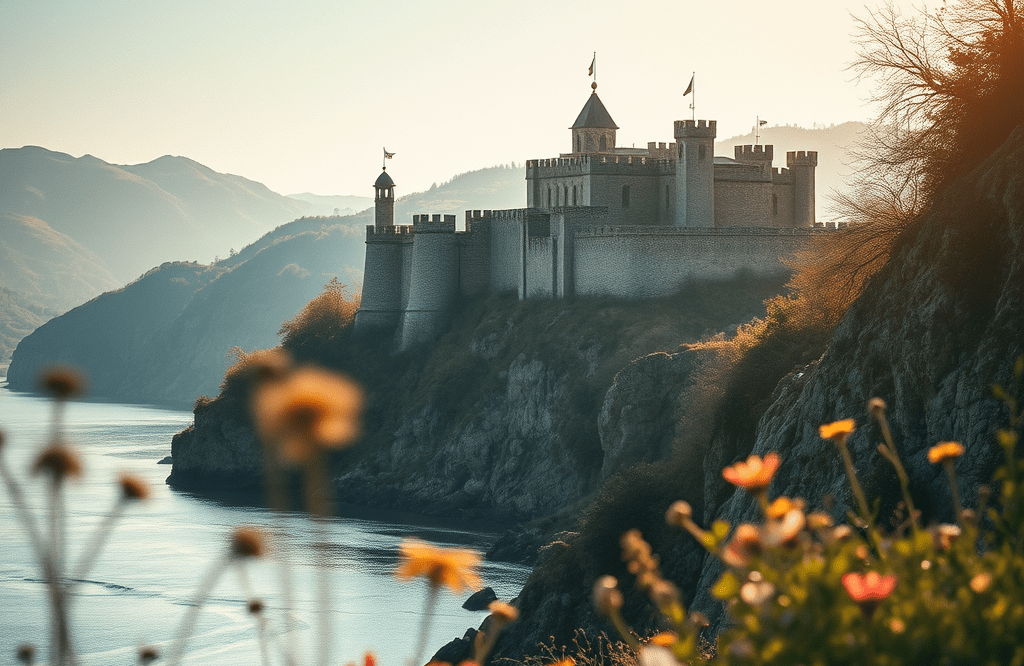
As we approach, the wind from the Danube brushes against our faces — cool, carrying the scent of water and wildflowers growing between the ancient stones. The air tastes faintly of iron and river mist. Before us rises the fortress, strong and proud, its nine towers reaching toward the sky, its walls sun-warmed and scarred by time.
For centuries, Golubac has stood here, feeling the gentle caress of the Danube on its foundations. Its stones have seen empires rise and fall — Hungarian soldiers once marched along these ramparts, Serbian defenders fought desperately in its courtyards, and Ottoman banners fluttered from its towers.
If the Danube could speak, it would tell of blood and beauty, of doves and battles, of love and betrayal.
The fortress first appeared in written records in 1335, when it served as a Hungarian garrison. But its true story began long before that — in whispers and in legend. Its very name, Golubac, comes from the Serbian golub, meaning dove.
They say that where there are doves, there are souls at peace — but here, peace has always been fleeting.
Let’s step inside.
The ground beneath our feet feels uneven, stones worn smooth by centuries of footsteps. The walls rise tall around us, sheltering the echoes of the past. Somewhere above, you can hear the flutter of wings — the doves still live here, just as they did in the stories.
One legend tells of Golubana, a woman whose beauty was her undoing. The Ottoman commander desired her, but she refused him. Angered, he tied her to a rock by the river, forcing her to “repent.” The rock became known as Baba-Kaj, “Father, repent.” When the wind sweeps over the Danube, listen — sometimes, they say, you can still hear her name in its sighs.
Another tale speaks of Princess Elena, imprisoned in a tower so high that only the doves kept her company. That tower — the tallest of all — is called the Hat Tower. Let’s climb toward it.
The stairs spiral upward, narrow and cold beneath your hands. The air grows thin, carrying the scent of damp stone and ancient wood. When we reach the top, the Danube stretches wide below us — nearly six kilometers across, glittering like liquid silver in the sunlight. The wind tugs at your hair, whispering old words in a language long forgotten.
Look — the Hat Tower stands on the Ridan cliffs, built on the highest and most prominent point. Imagine the princess looking out from here, her gaze lost on the river, her only companions the soft coos of doves.
Let’s continue our journey.
We pass through the watchtower, where soldiers once scanned the horizon for enemy ships. The view makes your heart swell — the vast river below, the echo of distant waves against stone.
Further along is the defense tower, where cannons now rest in silence. Once, they roared over the Danube; now, they merely frame the view.
We reach the fourth tower, where the soldiers once slept. Inside, the air smells faintly of dust and history. There’s a small chapel here, and you can almost hear the echo of prayers once whispered under torchlight. Archaeologists found over 7,000 arrows and fragments of segmented armor nearby — relics of those who fought and fell within these walls.
From here, we walk to the fifth tower, built during the reign of Despot Stefan Lazarević. It’s taller, with two entrances — one from the palace and another from the ramparts. When the wind blows through its stone windows, it sounds almost like a sigh — perhaps of the guards who once stood watch here, or of time itself passing.
We climb higher, to the sixth and seventh towers. The stones here are cooler, older. The seventh was once a dungeon, dark and silent, where the air still carries the faint chill of captivity. Yet step outside, and the view takes your breath away — green hills rolling into the distance, the Danube shining below, and the fortress stretching like a sleeping giant around you.
Close your eyes. Feel the wind, heavy with history. Imagine the footsteps of soldiers, prisoners, and lovers. How many lives have brushed against these walls? How many hearts have listened to the same river’s song?
Now, let’s move toward the main gate tower — its walls thick and heavy, its stones blackened by battle. During the Ottoman period, it was reinforced with battlements and adjusted for newer weapons. You can still see the marks — cracks from cannon fire, pockmarks from bullets, each one a memory. Inside, the air is cool and smells faintly of rust and old wood. The lower levels once stored weapons and food — the lifeblood of survival during sieges.
Finally, we come to the Cannon Tower, built later in the Ottoman era to guard the harbor. Here, the scent of the river is strongest. You can almost taste the salt of history in the breeze. The Danube glides beneath, vast and eternal, carrying whispers from centuries past.
When we step into the palace, it feels like entering another world. The fortress is divided into two parts — the inner fort, where the great Donjon (Hat Tower) rises above everything, and the outer fort, the first line of defense against enemies.
Today, a modern road cuts through the fortress — but even as cars pass by, the stones still hum with old stories.
Listen carefully. Can you hear them? The laughter of soldiers by the fire. The weeping of a princess. The distant cry of doves.
Golubac Fortress does not belong only to history — it belongs to the wind, the river, and to anyone who dares to listen.
I hope you enjoyed our trip, here you can find more informations: https://tvrdjavagolubackigrad.rs/eng/fortress/
 cursedtraveler