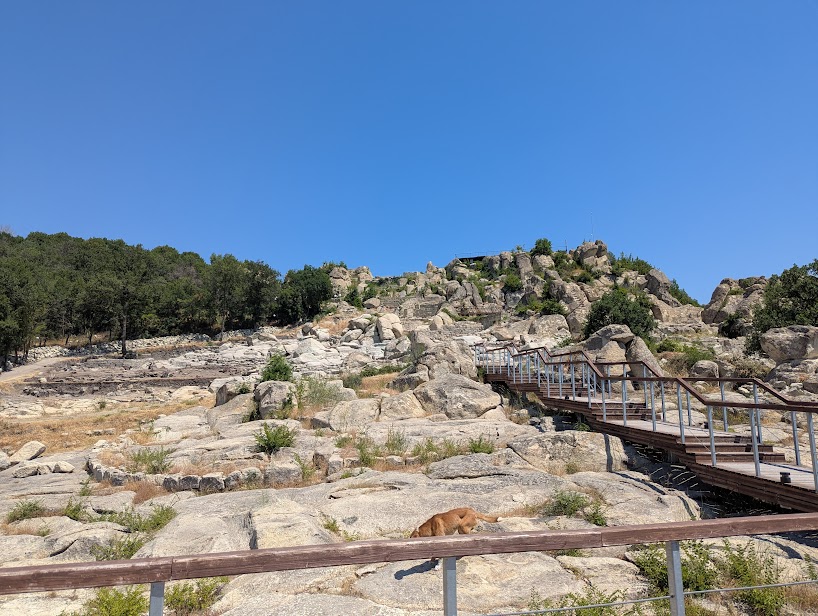
Today, I’ll take you on a new journey — to Bulgaria, to see an ancient city, fortress, and temple. Our steps will follow a path through the Rhodope Mountains. Don’t worry, it’s not a tough hike since this place lies at around 470 meters altitude. This land is full of history. Legend says here stood one of the most famous oracles of Dionysus, which made predictions for two great figures in history. But first, let’s dive deeper and see who Dionysus was, and why people worshiped him. Grab my hand, because we’re about to travel back in time — to an era where Olympian gods mixed with Thracian deities, right here in the land of the Thracians.
Dionysus was the Greek god of wine and ecstasy, though he actually descends from an older Balkan nature god. The Thracians, who lived here, likely called him Zagreus.
This male nature god was closely connected to the Great Mother Goddess. Their union symbolized the joining of agriculture and wild, ecstatic celebrations.
In Greek myths, Dionysus was the son of Zeus and a mortal woman named Semele. Zeus’ wife, Hera, jealous of Semele, tricked her into asking Zeus to reveal his true divine form. Zeus complied, but his divine glory was too much for Semele — she was struck down by lightning. Zeus saved the unborn child by sewing him into his thigh. Dionysus was then raised by wild female followers called bacchantes.
Another story tells us Dionysus was first born as Zagreus, son of Zeus and Persephone. Hera’s jealousy led her to convince the Titans to kill and devour Zagreus — except for his heart. Zeus punished the Titans with lightning and later used Zagreus’ heart to create Dionysus, born again from Semele. This Dionysus is the same god later called Bacchus by the Romans.
The wild, nature-loving spirit of the early Thracian god lived on in the famous Dionysian festivals — the Dionysia or Bacchanalia. These were wild nighttime celebrations with drinking and torchlight, usually held during the longest winter nights in the mountains.
It seems that somewhere here in these mountains stood a temple dedicated to him — a temple with an oracle. Following this thread of history, we might meet the priestess who predicted Octavian Augustus’ rise to power, and before him, perhaps even Alexander the Great was foretold to conquer much of the world.
One of the most famous stories comes from Suetonius, a Roman historian. He wrote about Octavian’s father visiting the Temple of Dionysus in the Rhodope Mountains. The prophets sat in an open, roofless oval room. Suetonius says:
“When Octavian, father of Augustus, led his army to the Holy Mount of Dionysus, he asked the oracle about his son. The prophets told him that his son would rule the world. This was shown when wine spilled on the altar, and the smoke rose high above the shrine — just like it did when Alexander the Great sacrificed there.”
So, two momentous prophecies were made on the Holy Mount Rhodope: one telling Alexander he would conquer Asia, and another promising Rome would build a world empire. These predictions used wine and fire — wine poured on the altar, and the flame’s height revealed the gods’ answer. Other Thracian Dionysus temples, like those of the Bisaltians, used the same ritual to predict harvest richness by watching the flame.
Wine and fire were the main symbols of Dionysus. Winemaking itself was seen as a sacred story about the god’s life and struggles. Crushing grapes symbolized how the Titans tore apart the Thracian Dionysus. The ritual was often accompanied by slow, mournful songs — like a sacred lament.
Near Perperikon, thousands of winepresses were carved into the rocks. These presses formed a complex system of basins and canals — veins carrying Dionysus’ sacred juice. This juice was used to keep the fire burning on his altar or to fill cups during wild celebrations in his honor.
Besides its fame as a worship site, the area was known for gold.
Another reason the area was famous in ancient times was for mining gold, silver, and precious stones. One of the largest ancient mines was near the modern village of Stremtsi, just a mile and a half from Perperikon. Today, about a dozen mine entrances and over 500 meters of tunnels remain visible. The hillside is crisscrossed by a dense network of underground tunnels and caves.
During the Pleistocene period, this site was likely the bed of an underground river carrying gold-rich sediment. Later, the rock above collapsed, drying the river and hardening the gold deposits. Ancient miners crushed the rock into gravel, then washed away lighter sand with water from a nearby river, separating the gold.
Inside the mines, gold-rich gravel was crushed underground and brought to the surface through vertical shafts. These shafts had holes in their walls, probably to hold lifting equipment and to provide fresh air. Once on the surface, the gravel was washed in the river to remove sand and leave the gold behind. Today, piles of leftover rock can still be seen. Small rivers near Perperikon still carry gold particles; one river’s name, Perpereshka, means “gold-bearing.”
Even the name itself may be connected to gold. Archaeological finds show mines near Stremtsi were developed in the last centuries BC but later abandoned. They reopened in the Middle Ages, between the 11th and 13th centuries. The name “Perperikon” dates from then. The original was “Hyperperakion,” but ancient writers shortened it to Perperakion or Perperikon. In Greek, “hyperperos” or “hyperpyros” means “fiery beyond fire” or “above fire.” This word relates to sacrifices on altars in Aristotle’s time, so the name might connect to Dionysian rites.
Another idea links the name to a gold coin: In 1082, Byzantine Emperor Alexius I Comnenus reformed the gold coin system. A new 21-carat gold coin called “hyperpyron” or “perpera” was made. Some think the city’s name came from this coin or the gold melting process. Since Alexius was a scholar of ancient history, he might have chosen the name to honor the old Dionysus cult.
Whether the city was named after the coin because of nearby mines, or the coin was named after the ancient holy city of Dionysus (whose name isn’t found in earlier records), remains a mystery. Archaeologists continue to study it. But until they decide, let’s move to another time.
Grab my hand — we’ll go to when the Roman Empire embraced Christianity. For a long time, Christians were persecuted. Constantine, fighting for the throne, gained power with the help of Christian soldiers. Christianity soon became the empire’s official religion.

Yet in the Rhodope Mountains, things stayed the same. The Bessians — a tribe known for never obeying rulers — kept worshiping Dionysus and using his temple on the Holy Mount. It took almost another hundred years before the Thracians here converted to Christianity.
The delay was partly due to outside events. In the 4th century, barbarian tribes attacked the Roman Empire from the north. The Visigoths, pushed south by the Huns in 376 AD, crossed into the empire and rebelled. They defeated Roman Emperor Valens near Adrianople in 378 AD and killed him.
Ironically, this destruction helped Christian missionaries reach the pagan Rhodope tribes. Paulinus of Nola, a Christian writer, said Nicetas, Bishop of Remesiana, began Christianizing the Rhodope, which continued through the 5th century. Paulinus praised Nicetas, saying the fierce Bessians became gentle like lambs and embraced Christianity. He described how their mined gold became a blessing for their souls. The once dangerous mountains now sheltered monks who renounced war to live peacefully.
To aid conversion, Scriptures were translated into the Bessian language — normally only Greek, Latin, and Hebrew were sacred languages. Legend says this Biblia Bessica was made in a Bessian monastery deep in the Rhodopes.
Today, no trace of that early Christian site remains. But it was likely in Perperikon, the holy city. Archaeology shows Christians didn’t destroy old Thracian temples but transformed them into churches, just as they themselves had been converted from pagan beliefs. So, if the famous Temple of Dionysus was at Perperikon, the early Christian center probably was too.
Grab my hand — let’s travel again. Between the 5th and 7th centuries, Perperikon was likely the seat of an early Christian diocese.
The riches of the Eastern Rhodope Mountains attracted the Bulgars in the late 7th century. They settled between the Danube and Balkan Mountains, forming the first Bulgarian Empire. The local population, with many Slavs since the late 6th century, welcomed the Bulgars’ arrival. Byzantine historians said Bulgars succeeded in raids partly because locals supported them.
From the 8th to the 12th centuries, Perperikon became a regional center under Byzantine Constantinople. Later, the Second Bulgarian Empire conquered the area after the Asen brothers led a revolt in 1185 to free Bulgaria. During the war between their brother Kaloyan and the Fourth Crusade knights, the Eastern Rhodope was Bulgaria’s southernmost stronghold. The empire peaked under Tsar Ivan Asen II (1218–1241) but weakened after. In 1246, after Ivan’s sons died or ruled under Byzantine influence, parts of the Rhodope returned to Byzantium.
In 1254, Michael Asen tried to reclaim these lands, capturing many cities and fortresses, except Mneakos, which resisted. The Bulgars’ last attempt to control the Rhodope was in 1343 during a Byzantine throne dispute. Tsar Ivan Alexander gained Plovdiv and Perperikon, appointing a governor there. A letter sealed with Ivan Alexander’s gold ring was found at Perperikon. However, Byzantium soon retook Perperikon, and the Bulgarian garrison surrendered. Years later, the Ottomans invaded, conquered the Rhodope, and destroyed Perperikon’s fortresses, leaving them in ruin.
Recent research shows Christian settlements near Perperikon survived Ottoman rule (15th–19th centuries). The Rhodope Mountains remained a stronghold of Slavic culture until Turkish colonization and population changes in the late 18th and early 19th centuries.
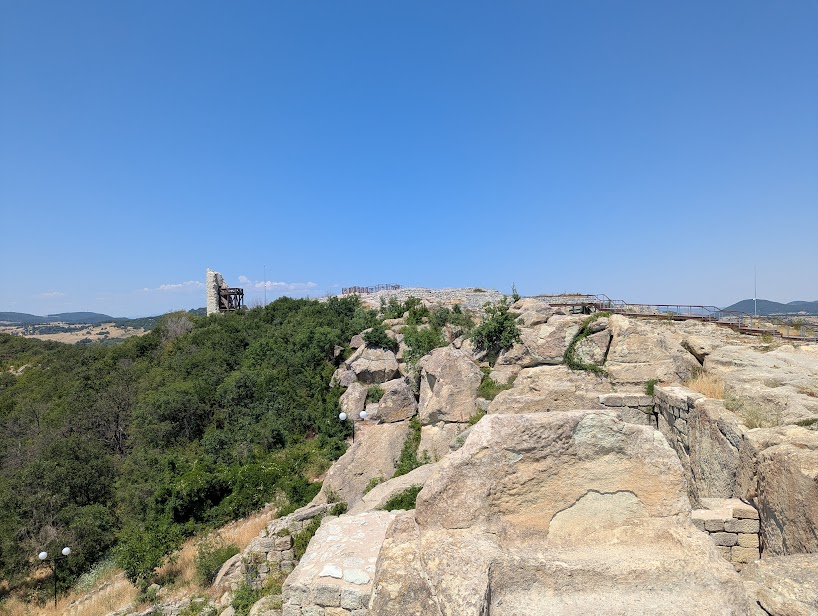
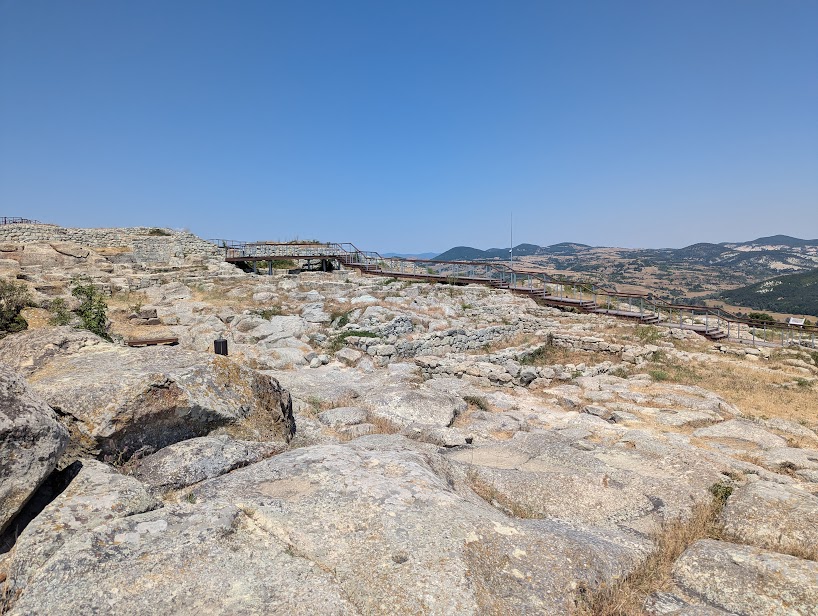
Historical records and archaeological discoveries support this. Speaking of archaeology, let’s return to the present and see what remains of the city inhabited for so many centuries. From the city’s summit, we enjoy a beautiful view of the surrounding lands.
As we walk, let me share another story — one that adds a powerful, almost mystical layer to Perperikon’s long history.
On August 21, 2002, archaeologists made a remarkable discovery at the base of the ancient city. Buried within the ruins of a Christian worship site, they unearthed a small bronze pendant shaped like a cross — a reliquary. These crosses are known as Palestine crosses, believed to have originated from the Holy Land itself.
Experts dated this particular pendant to the 9th or 10th century, based on its intricate style and religious iconography. On one side, it shows Christ alive on the cross, dressed in a long robe — a powerful and hopeful image of divine sacrifice. On the reverse, the Virgin Mary is depicted in prayer, her hands raised in supplication, pleading for her Son’s mercy on humankind.
But the real miracle came months later, when the pendant was carefully opened in a lab. Inside were tiny, timeworn fragments of wood. Scientific tests confirmed that it was indeed ancient wood — though too little to determine its type or exact age. Still, there was little doubt among the experts: this may have been a fragment of the True Cross — the very cross on which Jesus Christ was crucified.
According to legend, the True Cross was discovered by Saint Helena, mother of Emperor Constantine the Great, during her pilgrimage to Jerusalem in 326 AD. The relic was brought to Constantinople and venerated there until 1204, when Crusaders sacked the city, looting many of its treasures — including pieces of the True Cross.
During the Middle Ages, relics like these — often encased in ornate containers called staurotheques (Greek for “cross boxes”) — spread throughout the Christian world. Only two such reliquaries had ever been found in Bulgaria prior to this: one in Pliska and another in Veliki Preslav, the first capitals of the Bulgarian Empire.
So when this third relic surfaced here, at Perperikon — in a place already steeped in spiritual power — many saw it as a sign. A rare and sacred moment in modern archaeology.
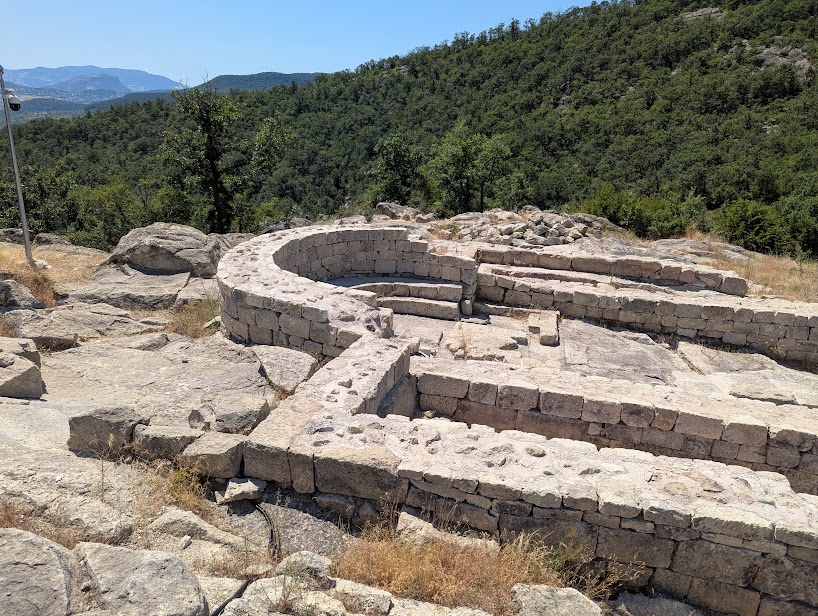
On December 1, 2002, hundreds of faithful gathered for a solemn procession. They carried the reliquary through the streets to the Church of the Dormition of Mary in Kurdzhali. There, it was placed in a specially crafted wooden box for safekeeping — a new chapter in its long and mysterious journey through time. New explorations of the site are to be continued
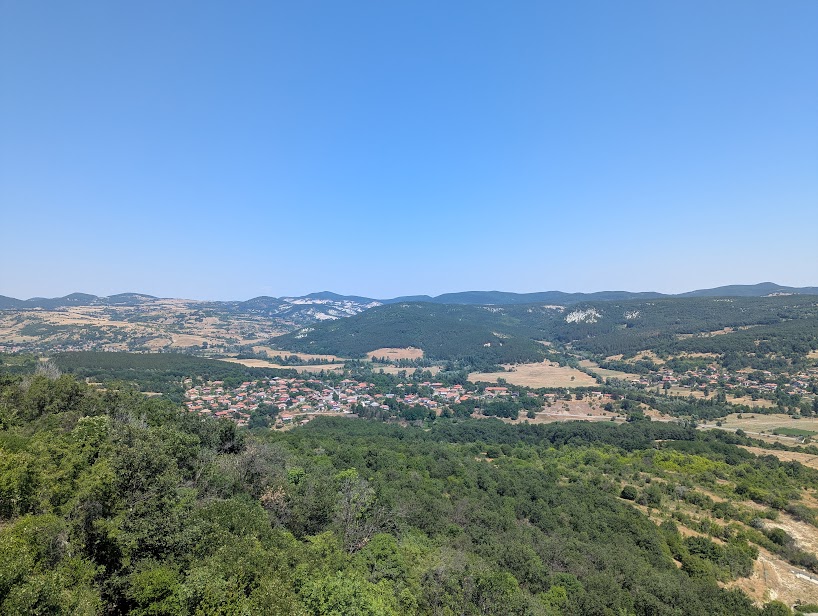
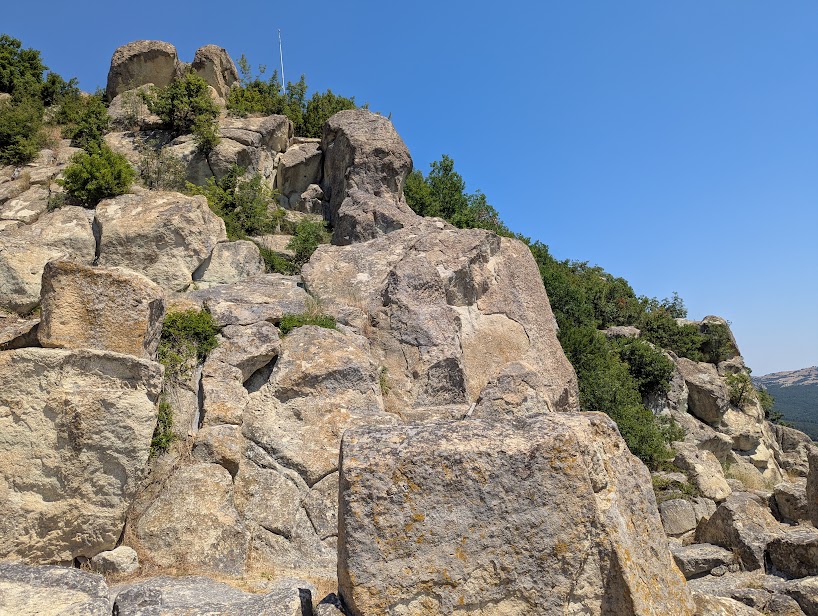
I hope you enjoyed this place lost in time and admire the massive stones the city was built from — the temple, the church — and feel beneath our feet centuries of history still waiting to be explored.
 cursedtraveler