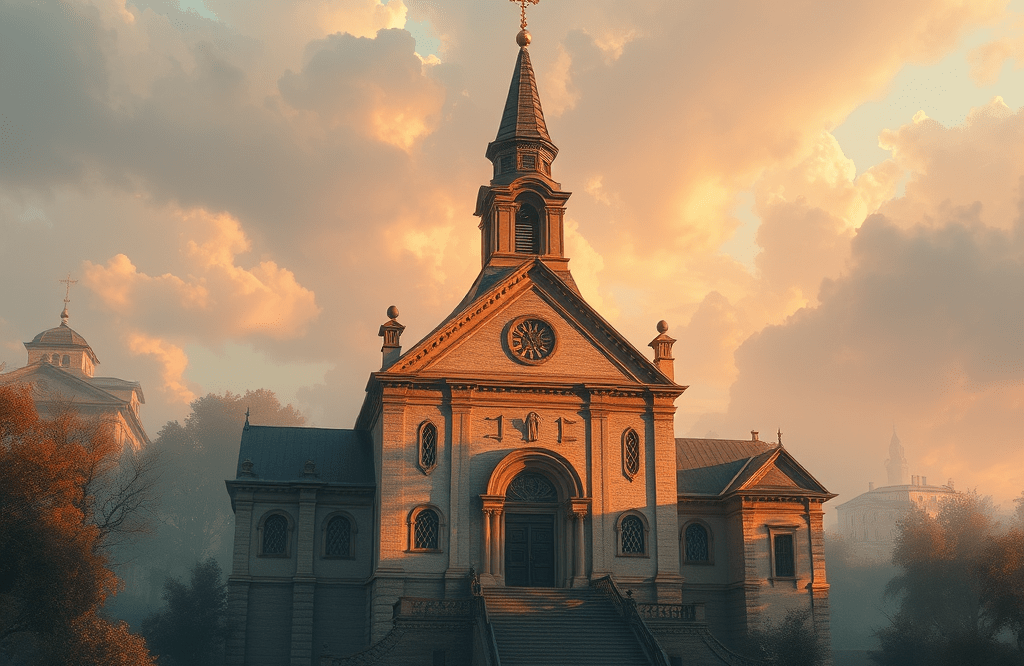
Today, I would like to take you on a new journey. We will visit a church rich in history. Grab my hand, and let’s enjoy the experience together. The church is located in the heart of Bucharest and is called Schitul Darvari. Once a place for monks, it is now a church open to everyone.
You might ask, “Who built the church?” Well, in 1834, Mihail Darvari and his wife, Elena, purchased land from the Băbeanu family (who built the Icoana Church). This land, which was most likely reserved for a cemetery, became the site where the Darvari family constructed a small church without a steeple. Initially, the church was not named after its builders; the people referred to it as the “Cemetery Icoana,” because the area had once been a cemetery.
A year later, the Darvari family brought nuns from nearby monasteries in Bucharest, Ciorogrală, and Pasărea. The nuns were responsible for managing four buildings in Bucharest to support themselves and maintain the church. This arrangement lasted for almost 30 years. However, in 1864, the nuns were relocated to monasteries outside Bucharest. The hermitages remained abandoned until 1869, when some monks from Romanian monasteries on Mount Athos, passing through Bucharest, decided to settle there. These monks, who lived off their own resources, started a small publishing house and a candle factory to meet their needs.
By 1894, the church was in a state of disrepair, so Nicolae Darvari, the church’s epitrop, decided to rebuild it. He added a steeple, and the church was restored. By 1902, seven monks were living at the church under the guidance of an elder monk. In 1889, Father Dometie Ionescu printed an anthology of hymns composed or translated by teacher Nectarie Protopsaltul. In 1909, Father Dometie published another anthology, this time including psaltic chants and star songs.
Fast forward to 1933, when the church underwent significant restoration, or rather, was almost entirely rebuilt in the Oltenian style. The charming look of the church was preserved, along with the old hermitages, the small steeple in the Secession style, and the small abbot’s residence. The church was painted by the renowned artist Iosif Keber, and this reconstruction has been maintained to the present day.
In 1959, by law, the church became a simple one, no longer home to nuns or monks. The 13 monks residing there were relocated to Cernica Monastery. In 1989, the paintings in the church were restored. After the revolution of 1989, the church became the home of a foundation that organizes various events. In 1992, it was declared a historical monument. In 1996, it became a monastic church once again.
I hope you enjoyed this trip with me. For more information about events related to the church, and to view pictures, please visit the official page.https://www.schituldarvari.ro/index.php?page=home
 cursedtraveler