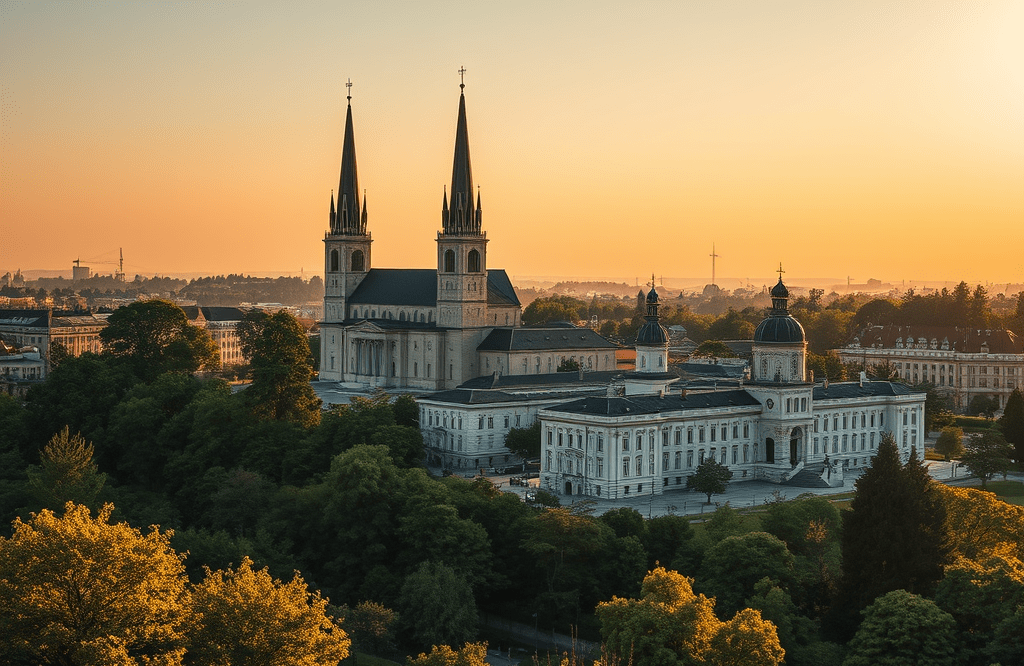
Today, I will take you on a new trip to the Mitropoliei Hill. Let’s explore how the buildings in this area have evolved over time. I will guide you on a walk through one of the hills of Bucharest, many of which still exist today. In the past, Bucharest had several hills, including Radu Vodă Hill, Spirii Hill, Filaret Hill, Cotroceni Hill, Vacărești Hill, and the Hill of Mitropoliei.
The Hill of Mitropoliei is located in the center of Bucharest, near the Dâmbovița River and the Old Court. This hill was chosen by ruler Constantin Șerban in 1656 to build a church. He modeled the church after the one in Curtea de Argeș, with four large spires. Unfortunately, he did not live to see the church completed; it was inaugurated in 1658 in the presence of Patriarch Macarie of Antioch. Ten years later, this church became the patriarchal cathedral of the country when Radu Leon Vodă, advised by Metropolitan Ștefan, moved the metropolitan see from Târgoviște to Bucharest. (Târgoviște had once been the capital of Wallachia.)
Near the church, the Metropolitan Palace was built, completed in 1708. This palace would later be incorporated into the grand building that still stands today (constructed in 1936) and serves as the headquarters of the Romanian Patriarchate.
Inside the church, you can find the holy relics of Saint Dimitrie Basarabov. Let me tell you how his remains came to Bucharest and how he became the patron saint of the city. The story goes that during the Russo-Turkish War (1768-1774), the Russian armies were forced to retreat from south of the Danube. To prevent the relics from falling into Turkish hands, the Russians took the coffin containing the remains of Saint Dimitrie from the church in the Bulgarian village of Basarabovo, near Rusciuc. The saint is believed to have lived in the 13th century. The Russian general Saltikov intended to take the relics to Russia, but when he passed through Bucharest, he stopped at the Mitropoliei Monastery. Here, a miracle occurred: the coffin could not be moved. This was interpreted as a sign that the saint wanted to remain in Bucharest. During times of drought, the saint’s coffin was taken out and carried around the city, hoping for a miracle. The people of Bucharest had similar hopes during the great fire of 1847.
In 1830, the hill was covered with vineyards. In 1832, the Russian general Kiseleff ordered the creation of a new boulevard that would lead up the hill, passing by the church and continuing to Filaret Street (today’s 11 June Street). From 1831 onward, the National Assembly of the country met in a hall on Mitropoliei Hill. A few decades later, between 1907 and 1908, the Parliament Palace was built on this hill, which would later become the Patriarchy Palace.
This hill has witnessed not only miracles but also political intrigue. On June 8, 1862, Barbu Catargiu, the prime minister of the first government after the union of the Romanian principalities in 1859, was assassinated here. He was shot as he exited a meeting and was in his carriage, passing under the arch of the belfry. The identity of the assassin remains unknown.
In addition to politics, religion, and history, there has also been some controversy here. In 1931, the authorities decided to move a statue of the wolf and the twins Romulus and Remus. The problem was that the statue had been placed facing away from the church, which was not well received by the church authorities. The statue was eventually relocated to Dorobanți Square in 1950.
Today, we can enjoy this historic place by walking up the hill from Piața Unirii and then descending along 11 June Street.
I hope you enjoyed this short trip with me!
 cursedtraveler