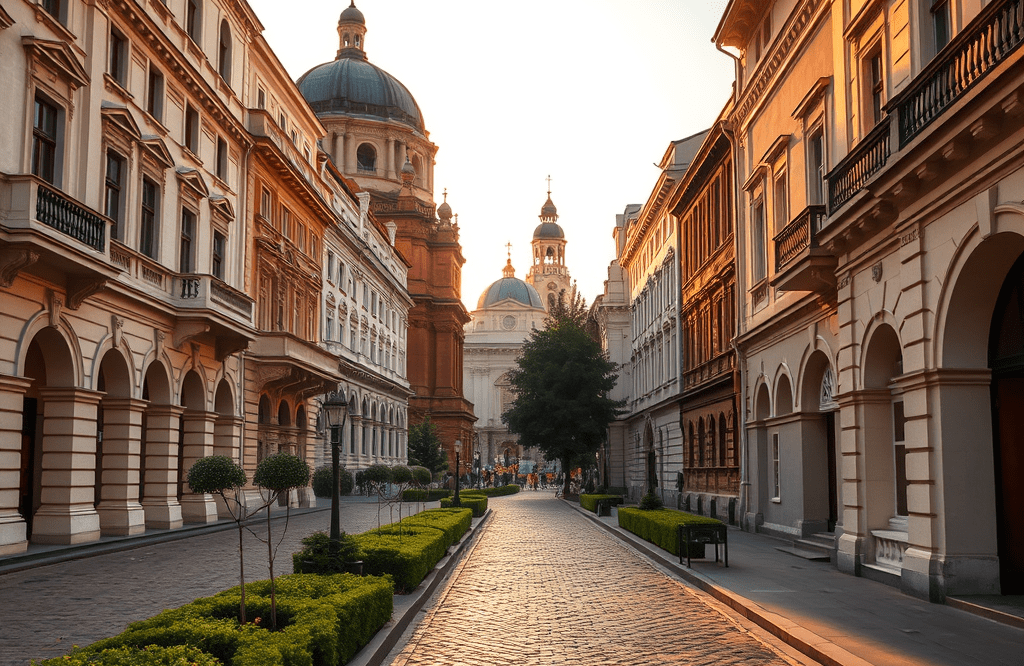
Today, I will take you on a new trip. We will walk along the most famous street in Bucharest, Calea Victoriei. Long ago, this street had a different name, so let’s explore its history and the stories it hides.
We’ll begin with the various names this street has had over time. The first mentions refer to it as “the Great Street” or “the way to Brașov,” as it was a major route leading to that city. A name that stuck for a long time was “The Bridge of Mogoșoaia.” This name dates back to the time of Constantin Brâncoveanu, who became ruler of Wallachia in 1688. Four years later, he ordered the construction of a road that would connect Bucharest to his estate in Mogoșoaia, where he built a beautiful palace in 1702. The estate was owned previously by the boyar Mogoș, and that’s where the name Mogoșoaia comes from.
This new road, or street, that the ruler built didn’t account for the properties of boyars Bălăceni and Cantacuzino, which lay in its path, marking what could be considered the first urban planning project in Bucharest. At the time, it was one of the longest streets, stretching from the hills down to the valley. In 1692, Brâncoveanu ordered the street to be paved with large wooden beams, giving it the name “The Bridge of Mogoșoaia.” This method of paving was an old technique used in Bucharest. While it had the advantage of protecting people from mud, it had its drawbacks. Over time, the wooden beams would decay, and if you were unlucky enough to step on a damaged one, you might break your leg or get stuck in the mud. Alongside the wooden beams, grooves were carved to drain rainwater, but these could also be dangerous if you weren’t paying attention.
The road served all kinds of traffic, from pedestrians to horse-drawn carriages. It would have been particularly hazardous at night since there was no public lighting at that time, something that would be introduced much later. The wooden beams remained in place until 1824, when the street was paved with river stones. These stones were later replaced with granite and sandstone cubes imported from Scotland, despite having high-quality local stone available. In the early 20th century, during World War I, asphalt was introduced.
Over time, Calea Victoriei became one of the most prestigious streets in the city, with grand houses alongside smaller ones. Many churches were built along the street, such as the Kretzulescu Church, constructed between 1720 and 1722 by Chancellor Iordache Kretzulescu. Nearby, at the northern edge of the town, was the **Well with Chain**, a landmark marking the city’s boundary.
Another significant religious site was the Zlatari Monastery, built in 1707 near the oldest part of the bridge. It was founded by Chancellor Mihai Cantacuzino, the same person who established the Colțea Monastery. The name “Zlatari” comes from the “zlatari” (goldsmiths) who lived in the area, as “zlat” means gold in Slavic languages. The monastery was located inside an inn of the same name, which had its entrancedecorated with a bell, it was located on the Mogoșoaia Bridge. In 1850, this inn had 200 rooms, with shops on the ground floor rented to merchants and rooms on the upper floors rented out to travelers. However, the inn had a reputation for being a place of vice, where drunkards and lecherous individuals gathered, and wealthy merchants often disappeared under mysterious circumstances. The inn was demolished in 1903.
Along the street was also the Sărindar Monastery, where the National Military Circle now stands (built in 1912). A fountain, still present today, serves as a reminder of the monastery.
Calea Victoriei was home to some of the most beautiful houses, belonging to powerful figures of the time. One example is the **Pană Filipescu House**, which was purchased by the former King of Serbia, Miloș Obrenović. He gifted it to Russia in 1841, and until 1917, it housed the Russian Consulate and later, the Russian Embassy. In 1934, the building was demolished and replaced by the current red-brick block.
Further down the street, around 1813, were the houses of Chancellor Dumitrache Ghica and Slătineanu, which were transformed by Caragea Vodă, the ruler of the time, into his court palace. From the balcony, which was adorned with Turkish divans, the ruler’s lady and daughters would sit and observe the happenings below.
At the beginning of the 19th century, the street began to shed its oriental style in favor of European influences. The houses of the boyars were replaced by palaces. Among them was the Stirbei Barbu Palace, built between 1833 and 1835 in the neoclassical French style. Nearby, there was an old, dilapidated wooden house that was said authorities wanted to be replaced but the owner refused to leave. A story goes that the man, a Romanian innkeeper, was offered a larger, more beautiful house, but he declined, saying he wouldn’t have such a great neighbor as the one he had.
By the 19th century, Calea Victoriei was known as one of the most beautiful and longest streets in Bucharest, full of contrasts, much like the city itself.
In 1813, the Romania Palace was built at the intersection with Calea Griviței. Today, it houses the Museum of Art Collections. In 1818, the first theater in Bucharest, Theatre of the Bridge of Mogoșoaia, was opened at the initiative of Princess Ralu. Performances took place in a room called “the Red Pump,” located at the intersection of what is now Calea Victoriei and Berthelot Street.
In 1847, the National Theatre was built on the site of the old Filaret Inn, according to the plans of Austrian architect A. Hefft. The theater had a capacity of 1,000 seats, with three levels of lodges and a gallery. It was inaugurated in 1852, with the first play being the vodeville “Zoe or Romanian Love”. In front of the theater, a market was created for the carriages that were conducted by famous muscals ( the coachmen). Later, the first five taxis in Bucharest would also park here, around 1912.
Another theater hall was opened in 1849 by Frederich Bossel, known for its performances and its festive parties. The guests at these parties sometimes engaged in scams, such as a woman convincing a man to buy a candy cone from her and then selling it to the waiter for half the price.
Near the Kretzulescu Church, the boyar Dinicu Golescu built a large two-story house in neoclassical style. In the time of Alexandru Ghica (1834-1842), this house became the palace of the ruler. Later, it was used as the office of the provisional government during the Revolution of 1848. The ruler Alexandru Ioan Cuza, who unified Wallachia and Moldova, also lived here until he was forced to abdicate in 1866. Afterward, the Hohenzollern family lived here as well. As the building was too small for court needs, a new wing was added to the right side along the street.
In 1878, the street’s name was changed to Calea Victoriei (Victory Way) to commemorate the victory of Romanian troops in the War of Independence (1877-1878), as the troops returned to Bucharest via this street.
In 1868, the first sweetshop on Calea Victoriei was opened at the ground level of the Slătineanu House by Macedonian-Romanian brothers Grigore and Constantin Capsa. This establishment became iconic for the Romanian people. In 1874, Grigore Capsa became the sole owner and added a restaurant, a hotel, and a café. It quickly became the meeting place for writers, intellectuals, and prominent citizens. In the summer, tables and chairs were set up outside, where people would eat ice cream, drink, and discuss politics, literature, and more. Wealthy women would often stay in their carriages and have their ice cream served to them. Others, who sought attention from men, would pass by, hoping for compliments or perhaps a rendezvous. This place remained the most fashionable in the city until 1948, when the communists came to power and nationalized it. After the 1989 revolution, Capsa Sweetshop was restored.
In 1882, Calea Victoriei became the first street in Bucharest to have public lighting. A Viennese company installed an electric power station near the Central University Library, providing power to the first electric bulbs in the Royal Palace, at the entrance of the National Theatre, and in Cismigiu Gardens. In 1884, a second power station was installed in the National Theatre building.
Another stunning building on Calea Victoriei is the CEC Palace, built in 1897 to house people’s savings. It was designed by French architect Paul Gottereau and stands on the site of the Saint Ioan the Great Monastery (16th century). Another impressive building is the History Museum, formerly the Postal Palace, built around 1900 on the site of the old Constantin Vodă Inn.
Throughout the street’s history, Calea Victoriei has also been home to the offices of most of the city’s newspapers. It has always been a busy and vibrant artery, where people and cars alike passed through, despite efforts by authorities to keep pedestrians safe by designating specific areas for traffic. At the end of the street, Victory Square (formerly Head of the Mogoșoaia Bridge) was reorganized during the time of Mayor Pache Popescu. The construction of the square was delayed by an inn, Niculcea, which refused to move. The story goes that the mayor, hired some men to pretend to be guests at the inn. At night they open fire using their can with petrols that they hidde in their bags, burning it down and providing an excuse for demolition.
In the early 20th century, the Public Clergy Palace was built in the square, but it was destroyed in 1944 by American and British bombs.
Another beautiful building along the street is the Grigore Antipa Museum, built in 1908, and the Sturdza Palace, which stood where the current government building is today. This palace, built in 1902, was replaced in 1936 by Palace Victoria, the current seat of the government.
I hope you’ve enjoyed this brief walk through time along Calea Victoriei, a street that embodies the spirit and history of Bucharest. From humble beginnings to the grand avenue we know today, it has witnessed the rise and fall of empires, the flourishing of culture, and the shifting tides of history.
 cursedtraveler