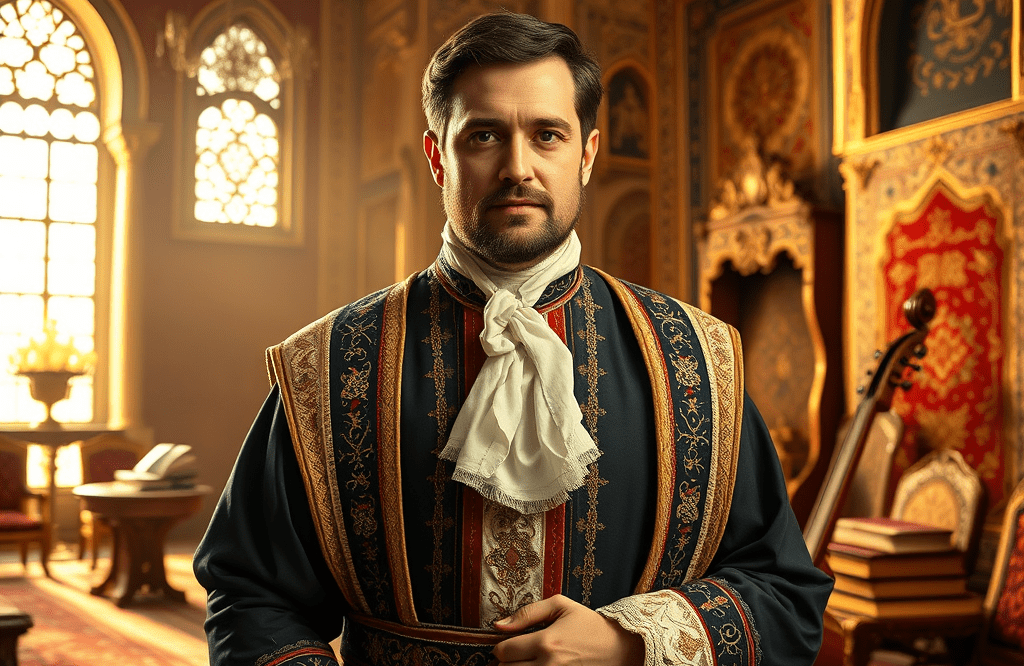
Today, we embark on an exciting journey back to the 18th century, this time exploring the fascinating life of Dimitrie Cantemir (1673–1723), a remarkable figure in Moldovan history. Born to Constantin Cantemir, who ruled Moldova from June 25, 1685, to March 13, 1693, Dimitrie’s life was shaped by the complex political landscape of his time. As a young man, he was sent to the Ottoman Empire as a surety—a custom intended to ensure loyalty from Moldovan rulers.
From 1688 to 1691, Dimitrie lived in Constantinople, where he immersed himself in the rich cultures of the Ottoman court, mastering Turkish, Persian, Arabic, Italian, Greek, and Old Slavic. His time there was not just about language; he honed his skills in music, philosophy, and history, quickly becoming a charming and gifted young man admired for his talents. His musical compositions, some of which can still be found on YouTube, showcase his artistic brilliance.
After the death of his father, Dimitrie was chosen by the nobility to rule Moldova, albeit briefly, from March 29 to April 18, 1693. However, his rule was not approved by the Sultan, leading to his expulsion back to Constantinople. Political intrigues complicated matters, especially as Constantin Brancoveanu, the ruler of Wallachia, sought to install his own candidate, Constantin Duca, as the new Moldovan ruler. Dimitrie found himself in exile.
In 1699, Dimitrie returned to Moldova, marrying the daughter of Serban Cantacuzino, a previous ruler of Wallachia. This marriage positioned him as a contender for power against Brancoveanu. The political chess game intensified when Brancoveanu secured alliances within the Ottoman court, leading to Dimitrie’s further complications, including a plot for his arrest and exile to Chios island. Yet, with clever maneuvering and friends, he evaded capture.
In 1704, Toma Cantacuzino attempted to broker peace between Dimitrie and Brancoveanu, but it turned out to be a trap, resulting in Dimitrie’s imprisonment. He managed to secure his freedom through a ransom, although his brother Antioh refused to pay for his release. Antioh briefly regained the Moldovan throne in 1705, during which Brancoveanu sought to mend fences with Dimitrie, offering financial support.
After a series of political shifts, Dimitrie’s time came when the Sultan appointed him ruler of Moldova, contingent upon keeping an eye on Brancoveanu. However, Dimitrie had other plans—he sought an alliance with Russia, securing Moldovan protection under the Russian Empire and the inclusion of southern Bassarabia as part of his domain. Peter the Great admired him, appreciating his intellect and leadership.
In 1711, Dimitrie faced a pivotal moment during the battle of Stănilești, where the Russians were defeated. A peace treaty followed, but the Ottomans sought Dimitrie’s return. He escaped in the carriage of the Empress, fleeing with his family to Russia, where he initially received over 50 villages and a generous pension, plus two houses in Moscow.
Tragedy struck in 1713 with the death of his wife, but six years later, he remarried. In Russia, Dimitrie became a trusted member of the Tsar’s senate and held various ministerial roles, contributing to modern reforms. He was not only a man of political prowess but also a social figure, hosting grand gatherings where he mingled with the emperor and participated in military expeditions, including the 1722 campaign against Persia.
Sadly, ill health struck, and Dimitrie passed away in 1723. He was buried in a Greek church in Moscow, with his remains later transported to Iași in 1935.
I hope you’ve enjoyed this captivating journey through the life of Dimitrie Cantemir, a man who navigated the turbulent waters of 18th-century politics, culture, and intrigue.
 cursedtraveler